
Online Business Tools Are Everywhere, and That Is Exactly the Problem.
It has never been easier to find software, traffic sources, AI platforms, autoresponders, hosting companies, training programs, and business opportunities. What's difficult is figuring out which of those things actually belong in your system—and which ones are simply another monthly bill.
That is the idea behind Online Techniques.
I've been marketing online in one form or another since 1993, when I put up my first primitive real-estate website in the early days of America Online.
At the time, having a real-estate website at all seemed a little crazy to people. There were only a handful of us in the Big Bear real-estate market doing anything like it.
In 2006, I began marketing products and services beyond real estate. Since then, I've watched platforms, programs, and marketing techniques appear, become the newest "must-have," and sometimes disappear almost as quickly.
The lesson I keep coming back to is simple:
You don't need every new tool. You need the right tools, used for the right reasons, working together.
Why Online Business Tools Need a System
A tool by itself is not a strategy.
You can buy a website, an autoresponder, an AI content generator, a traffic package, a funnel builder, and a social-media service—and still have no real business if none of those pieces are connected.
A useful system answers some basic questions.
Where does the traffic come from?
Where do visitors land?
How do you capture a lead?
How do you follow up?
What are you offering?
How do you build an audience you can reach again instead of starting from zero every day?
When those questions are answered, individual tools begin to make sense.
When they aren't, online business tools can quickly become nothing more than a collection of disconnected subscriptions.
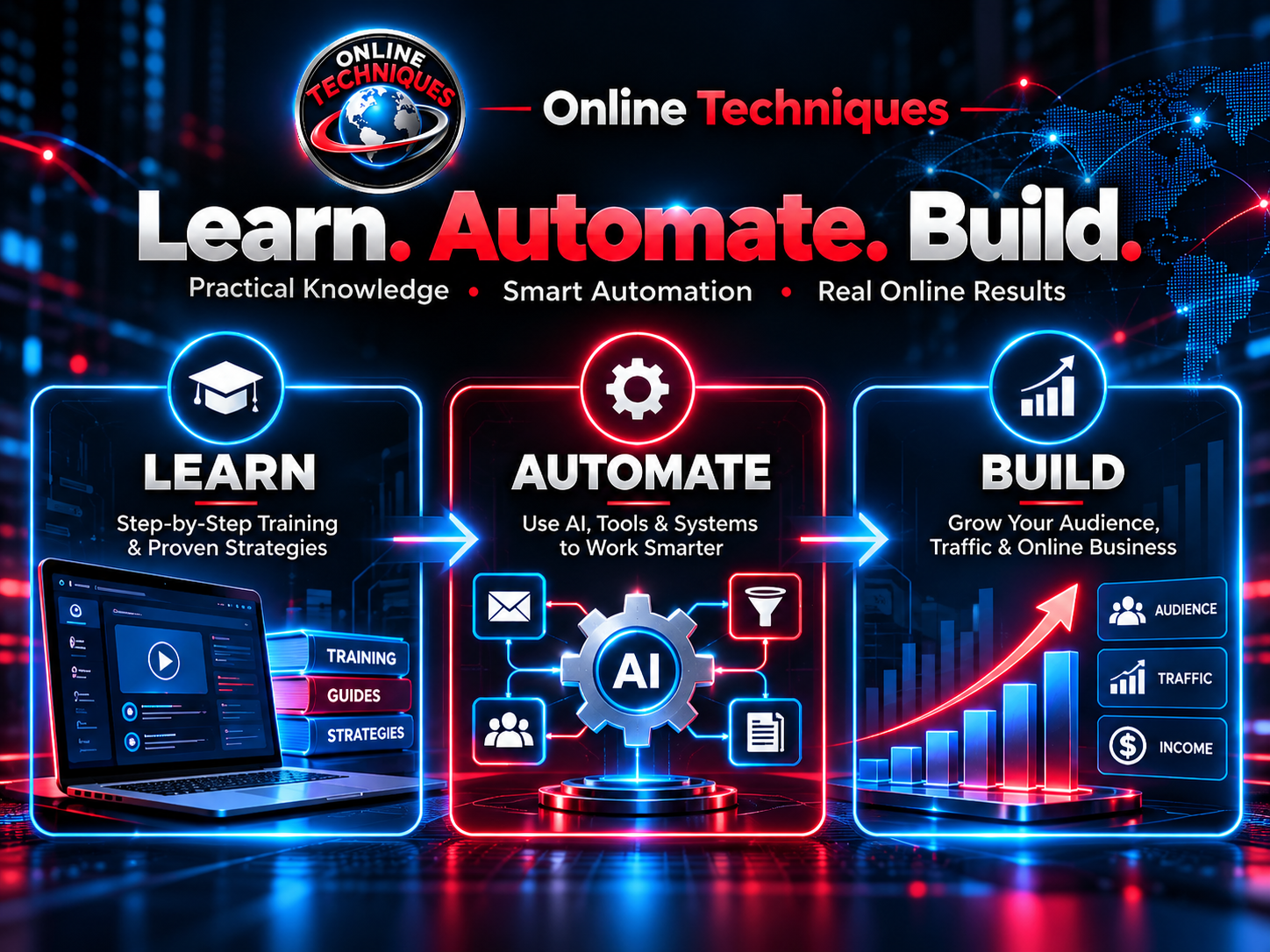
That is why Online Techniques is organized around what the tools accomplish—not around whatever happens to be generating the most hype this week.
Start With the Fundamentals
Before automation, before AI, and before complicated funnels, there are a few basic principles that continue to matter.
You need an offer.
You need traffic.
You need somewhere useful for that traffic to go.
You need a way to capture interested people.
You need follow-up.
That is one reason I continue to recommend Contact List Builder.
Its basic approach is straightforward: set up the funnel, send traffic to it, build the list, and follow up.
Those fundamentals may not be as exciting as the newest AI application, but they don't stop being important simply because technology changes.
In fact, the better the technology becomes, the more useful it is to understand what you're actually asking that technology to accomplish.
Online Business Tools for Traffic and Lead Generation
Nothing happens online until somebody sees what you're offering.
That is why traffic is one of the first categories I look at.
Different traffic sources serve different purposes.
LeadsLeap provides advertising and lead-generation resources.
Udimi provides access to a marketplace for solo-ad traffic.
Social media can create repeated exposure.
Blogging and search can bring people to useful content.
Video can introduce you to people who might never sit down and read a sales page.
The goal is not necessarily to find one traffic source and depend on it forever.
The goal is to generate enough useful exposure that you can move some of those visitors onto assets you control—your website, your content, your email list, and your follow-up system.
Traffic creates the opportunity.
What happens after the click determines whether that traffic becomes valuable.
Online Business Tools for Follow-Up and Automation
Once somebody shows interest, the next question is what happens afterward.
An autoresponder such as SendShark gives you a way to continue communicating after a visitor leaves your website.
A system such as NowOS can bring AI-assisted content, audience building, lead generation, and follow-up into a connected marketing process.
Automation matters because consistency matters.
A business can lose a tremendous amount of opportunity simply because nobody follows up, content stops appearing, leads are forgotten, or marketing happens only when somebody happens to have time.
But automation is not the goal by itself.
The goal is to automate the things that genuinely save time, improve consistency, and keep the marketing process moving.
AI can help create content.
Scheduling can maintain visibility.
Follow-up systems can continue conversations.
But somebody still has to decide what the business is trying to accomplish.
Your Website Is Still an Asset You Control
Platforms are useful.
But platforms change.
Algorithms change.
Rules change.
Accounts can be restricted.
Traffic sources can disappear.
That is why I continue to believe in owning as much of your central business infrastructure as you reasonably can.
A website gives you a home base.
Hosting gives you control over where that home base lives.
I use GVO for hosting and other online-business infrastructure because it gives me room to operate multiple websites and grow beyond a single small site.
Your email list gives you a way to reach people again.
Your articles, videos, and other content give you assets that can continue working long after a social-media post has vanished down somebody's feed.
Social media is enormously useful.
But I'd much rather use social media to bring somebody into an environment I control than build an entire business that exists only inside somebody else's platform.
Choosing Online Business Tools That Fit the Business
The best tool is not automatically the newest one.
It is not necessarily the most expensive one.
And it certainly isn't always the one with the longest feature list.
The useful question is whether it solves a real problem in the business you're building.
Does it help you generate traffic?
Does it help turn visitors into leads?
Does it help you communicate?
Does it save meaningful time?
Does it help create or distribute useful content?
Does it connect reasonably well with the rest of your system?
If the answer is no, it may be interesting software—but that doesn't mean you need it.
This is also why I don't believe everybody should use every program discussed on Online Techniques.
Some people need training first.
Some need traffic.
Some need better follow-up.
Some are ready for automation.
And some are looking for a more complete online-business structure and may want to investigate something such as the 2K Profit System.
The point is to know what problem you're solving before you add another tool.
How Online Techniques Evaluates Online Business Tools
I'm not interested in building a giant list simply so I can say Online Techniques recommends hundreds of products.
I'd rather explain a smaller number of useful resources clearly.
What does the tool do?
Where does it fit?
What kind of person is likely to benefit from it?
What problem does it solve?
And how does it relate to the rest of an online business?
That means you'll find resources such as Contact List Builder, NowOS, and the 2K Profit System discussed in depth.
You'll also find smaller tools and services—traffic sources, hosting, autoresponders, AI applications, and other resources—that may solve one particular problem well.
You don't need all of them.
You need the ones that make sense for what you're building.
Build the System, Not the Collection
The internet is never going to stop producing new software, new platforms, and new opportunities.
That is not the problem.
The problem begins when collecting tools becomes a substitute for building a business.
Choose carefully.
Generate traffic.
Capture leads.
Follow up.
Create useful content.
Automate what genuinely benefits from automation.
Keep as much of your audience and business infrastructure under your control as you reasonably can.
Then improve the system as you learn.
That is what Online Techniques is here to help with.
If you're new here, explore the tools and resources that match where you are now.
Start with the fundamentals if that's what you need.
Look at automation if you're ready to make your marketing more efficient.
Explore the business systems if you're looking for something more structured.
You don't need every online business tool.
You need the right ones working together.