
GVO web hosting provides the foundation for a part of an online business that people often overlook until something goes wrong: where their website actually lives. It is easy to spend a week choosing colors, headlines, and advertising tools, then almost forget about hosting, domain control, backups, or what happens if the site goes offline.
I have been putting websites online since the early days of the commercial internet. I still believe that a business needs a home base it can manage. Social platforms, affiliate programs, and advertising services are useful, but I wouldn't make any of them the only place where people can find your business.
GVO, or Global Virtual Opportunities, provides conventional web hosting, reseller hosting, and cloud dedicated-server options. I use GVO in my own online business work, and I value it primarily for the infrastructure it provides. Hosting isn't an exciting marketing gimmick, nor should it be. When everything is working properly, visitors barely think about it.
Why Your Website Still Matters
A Social Account Is Not the Same as a Business Website
I recommend social media to online marketers because it creates opportunities for discovery and conversation. Short videos, posts, and recommendations can send someone toward a product or article. But a social profile is rented space. The platform can change its rules, limit the reach of posts, or restrict an account. You may have an audience, but you do not control the environment in the same way you control your own website.
A website gives you an address that can appear in emails, videos, printed material, and advertising. It can introduce your services, organize your content, connect visitors to product information, and send them toward an offer. If you publish articles, those pages can continue providing useful entry points long after a social post disappears down the feed.
That does not mean owning a domain guarantees traffic. A website still needs content, promotion, and a reason for people to return. The advantage is that you have a place to put those efforts together. You can improve an article, add a landing page, or revise a product recommendation without rebuilding the business on another platform.
In my view, a good marketing plan uses different channels to reach people and uses the website to give those people somewhere worthwhile to go.
What Hosting Actually Does for You
Web hosting stores the files, databases, and software that let visitors view and use your website. If you run WordPress, for example, hosting supports the application and the database behind it. The domain name helps visitors find the site, while hosting makes the site available when they arrive.
That distinction sounds elementary, but it matters whenever something needs to be changed. A domain registration, hosting account, website builder, content-management system, and email service may involve different settings and responsibilities. If a visitor cannot reach your website, the reason could be a domain setting, a server problem, a software conflict, or something else entirely.
I prefer an arrangement where I can tell which component does what. If you know who manages the domain, where the website is hosted, how to enter the control panel, and how to restore a backup, you are in a stronger position when an issue appears.
It is also easier to grow. A straightforward site can begin with a homepage, an about page, and a few useful articles. Later, you may want more domains, databases, subdomains, or specialized applications. That is where choosing a hosting account begins to affect your options.
Control, Backups and Site Maintenance
Owning a website is not the same as never having to maintain it. Content-management systems and plugins need updates. Websites need security practices and usable backups. Hosting companies manage part of the infrastructure, but website owners remain responsible for what they install and how they configure it.
Before selecting a host, I would find out how backups work, whether restoration is straightforward, and what is actually included in the plan. I would also look at support availability, account access, and resource limitations. Marketing language such as "unlimited" should not replace reading the service terms and understanding how shared resources are managed.
I tell people to keep their domain credentials, hosting information, and website administration organized. If you later switch providers, keeping your domain registration separate and having a current backup makes that change much easier.
And do not wait until you need a restore to test a backup. A backup that has never been checked is a nice thought, not a reliable recovery plan. For a business website, the ability to recover is as important as the design.
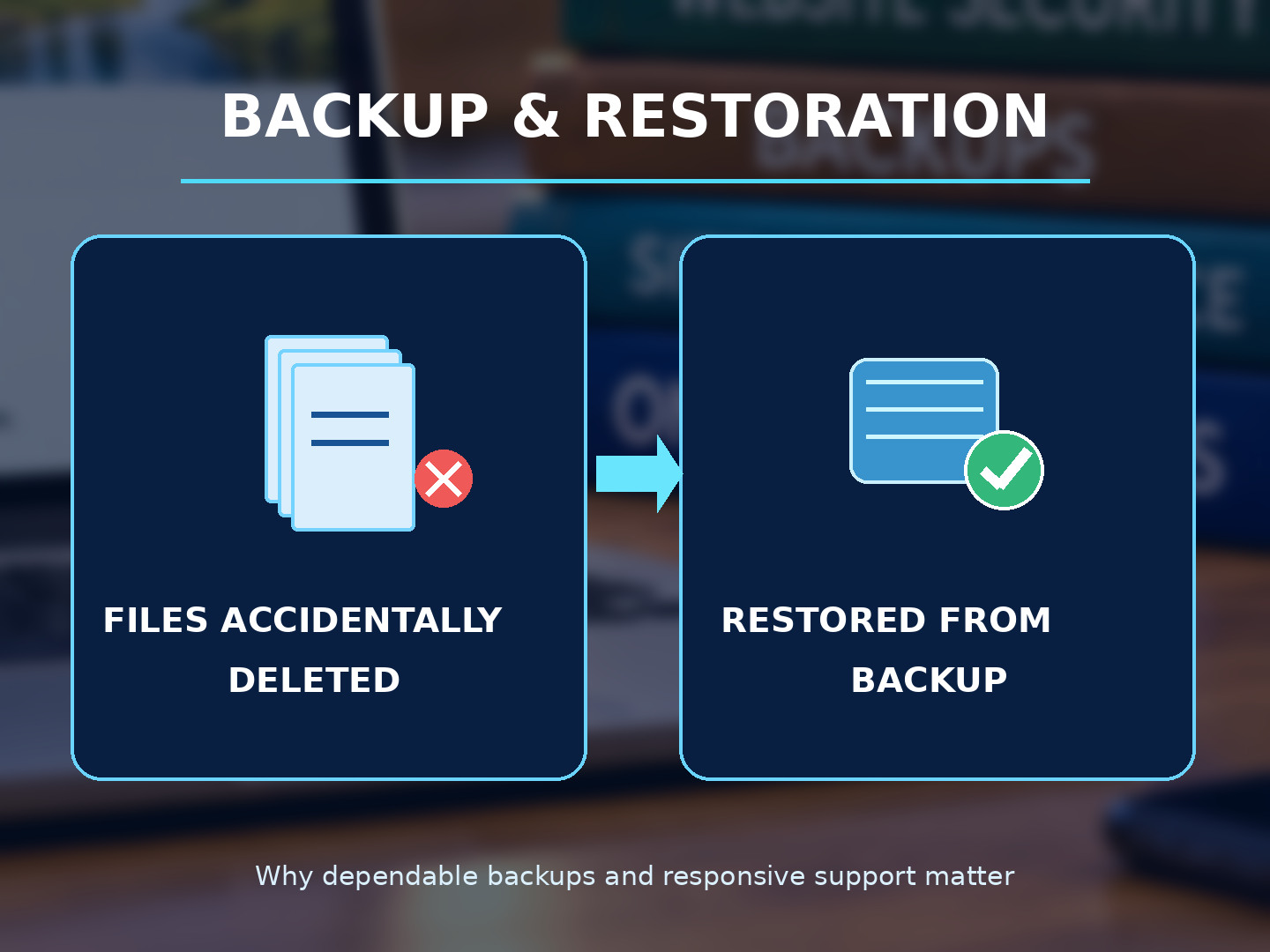
I learned the value of reliable backups through a rather embarrassing experience years ago. I was working on a client's website and using FTP software that I hadn't yet become comfortable with. In the middle of a fairly substantial job, I suddenly realized I was deleting files instead of managing them. By the time I stopped the operation, roughly half the website was gone. These weren't files sitting in a recycle bin waiting to be restored. They were deleted, and I was facing the very unpleasant prospect of explaining what had happened to my client.
Fortunately, the website was hosted with GVO. I contacted their support team, explained my mistake, and asked if they could help. They told me to give them a few minutes. About six or seven minutes later, the support representative asked me to check the website. Everything was back. They had restored the missing files from their backups, and the site was working again. GVO's support team saved my bacon that day, and I've never forgotten it. That experience also reinforced why I consider dependable backups and responsive technical support essential when choosing a hosting provider.
How GVO Works With That Foundation
Hosting Choices at Different Stages
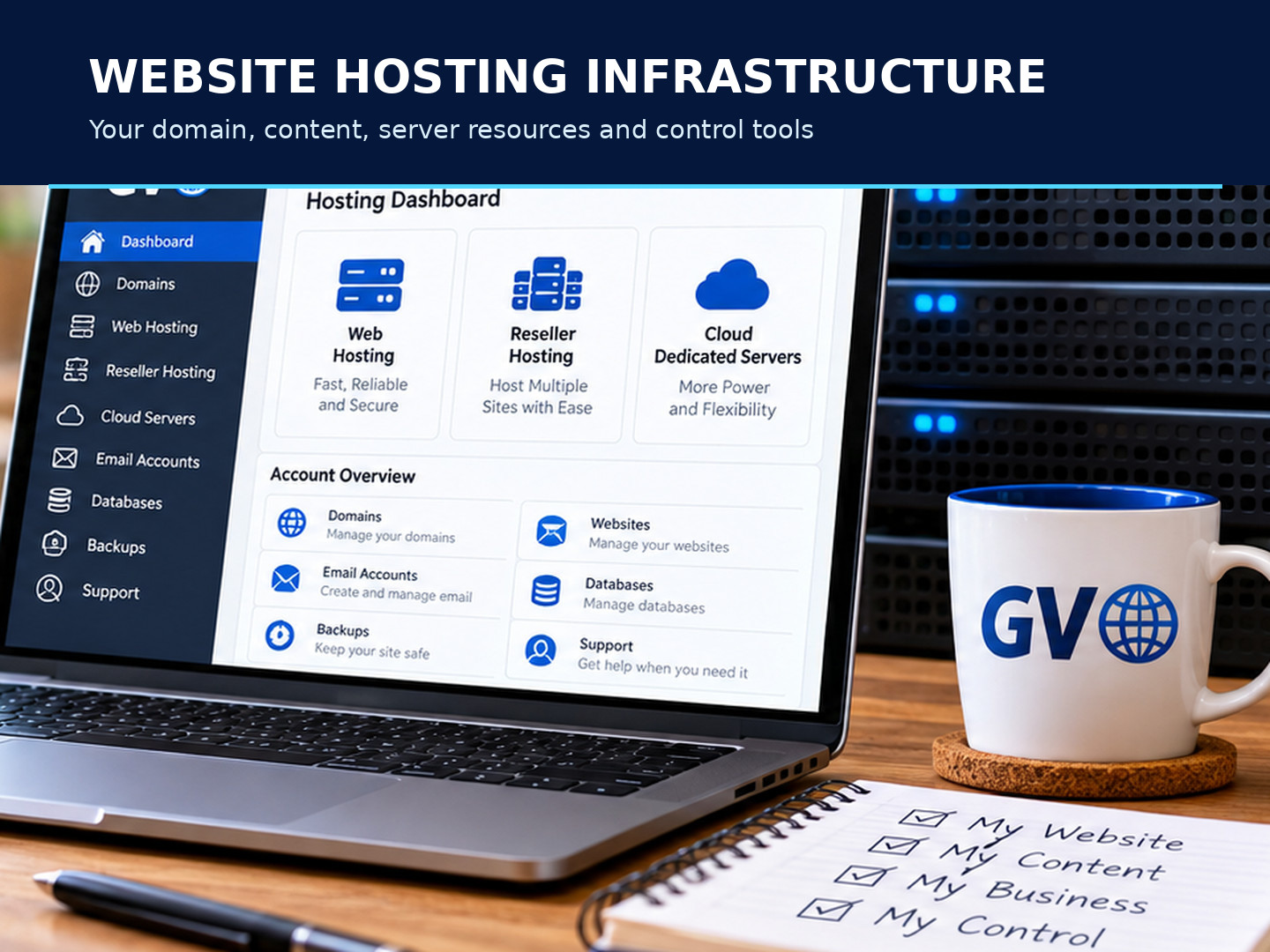
GVO offers web hosting, reseller hosting, and cloud dedicated-server options. That range matters because a beginner with one site needs different resources than a marketer or service provider who manages many sites.
If you start with one website, a basic hosting account may give you everything you need. The mission is to launch the site, keep it simple, and start adding content. Paying for server space you don't need won't improve your content or bring you an audience.
Reseller hosting matters when you manage sites or host for clients. GVO's reseller setup uses WebHost Manager, known as WHM, with individual cPanel accounts. WHM manages hosting accounts; cPanel gives each account its own controls for common website and email tasks.
A dedicated or cloud-server option falls into another category. It provides a different level of hosting resources and control, but you need to understand what you will manage. More control can be valuable, but it also brings responsibilities that a basic shared hosting account doesn't have.
I would pick the level that matches your workload, not the one that sounds the most impressive.
Why cPanel and WHM Matter
GVO's use of cPanel and WHM is familiar to those of us who have handled websites for years. These tools allow more than changing the appearance of a page. Depending on the account and permissions, you can manage domains, email accounts, database tools, file access, subdomains, and separate hosting accounts under a reseller plan.
For me, that access matters because a business website is a working project. You may need to set up a database, create a subdomain for a campaign, or find out why an email address isn't working. A control panel does not solve every problem, but it gives you practical tools and a clearer view of how the account is arranged.
There is also a distinction between the server and the website. WordPress handles content, pages, themes, and plugins. cPanel handles many underlying hosting tasks. WHM, where it is available, manages hosting accounts. Understanding that distinction makes troubleshooting more logical and helps you avoid changing unrelated settings when something goes wrong.
People who simply want to write a blog do not have to become server administrators. Choosing a provider that gives them appropriate control and support is still worthwhile.
Marketing Features Are Helpful, but Hosting Comes First
GVO also includes online-business and marketing tools in parts of its hosting lineup. Some reseller packages include resources such as email and promotional services. Those extras may appeal to a marketer who prefers to obtain several functions from one provider.
I would not choose hosting just because of a long list of bonuses, though. The main questions stay the same: Does the plan give the website the resources it needs? Can you maintain it? Are support and recovery arrangements clear? Can visitors reliably reach your content?
After those questions are answered, the bundled marketing tools can become part of the decision. If you already use another autoresponder or landing-page system, you may not need the host's equivalent service. Duplication can be handy as a backup in some cases, but it can also add unnecessary work and costs.
Online Techniques is built around selecting tools for the jobs they do. Hosting should support the website. Your content and marketing strategy should then give people a reason to visit.
What I Would Check Before Choosing a Plan
I would start with the number and types of websites involved. One informational site has different needs than an operation running several WordPress installations, client websites, mailing systems, or demanding applications. The account should allow room for growth without forcing an immediate move to a more complicated setup.
Next, I would review performance expectations, storage and transfer policies, account isolation, and support. I would ask which responsibilities belong to the provider and which belong to me for security, software updates, and backups. If migration assistance is offered, I would clarify what it covers before moving a live business website.
Finally, I would compare the full cost, not just a headline rate. Hosting plans can differ in billing periods, capacity, included tools, backup services, and other extras. I would check the details of the plan I am actually considering rather than assume every feature mentioned on a company's website applies to every account.
Those questions are not meant to make hosting intimidating. They prevent a business owner from discovering that an inexpensive-looking plan does not support the work the website needs to do.
Putting Hosting Into a Traffic Strategy
A web host does not bring an audience by itself. The value becomes clear when you use hosting to establish a site you can keep improving. For Online Techniques, that means publishing articles designed to attract new visitors, providing permanent information pages that explain the products we recommend, and giving interested readers a clear path toward the offers themselves.
A useful article might answer a question about traffic, email follow-up, or website automation. The reader can discover that article through search or social promotion, learn something, and move to a focused product page if the subject interests them. The product page can then point to the offer. The host makes those connections possible; the content and business decisions make the experience worthwhile.
This is the same principle I discussed in my earlier article, Online Business Tools: Build a Smarter System in 2026. The tools support the strategy, not the other way around.
That is why I consider hosting infrastructure rather than a magic solution. It is the ground the rest of the website stands on. If you are building a presence for the long term, you want that foundation to be understandable, manageable, and suited to the business you are actually operating.
Is GVO Web Hosting Worth Exploring?
GVO deserves consideration if you want conventional hosting with cPanel access, anticipate managing multiple websites, or are considering reseller hosting as part of a broader online operation. Its different hosting categories offer ways to match infrastructure to the size of the project.
It won't be the right fit for everyone. A beginner who wants nothing beyond a hosted page may prefer a different kind of service. An experienced administrator with particular performance or configuration requirements may need to compare specialized providers. No host should be chosen on the assumption that technical problems can never happen.
What matters is whether the account gives you the control, resources, support, and recovery options you need at a price that makes sense. A hosting provider should not be the center of your marketing strategy. It should make that strategy possible.
If you'd like to take a closer look at GVO and its hosting options, click here. Start with the kind of website you want to build, then choose a hosting arrangement that supports it. The goal is to establish a home base for your business, not simply rent space on a server.