
Getting people to visit your website is one thing. Getting the right people to visit—and giving them a reason to come back—is how an online business begins to take shape. You can build an attractive website, create a useful lead magnet, and set up email follow-up, but none of it does much good without traffic.
That is where solo ads come into the conversation. Instead of waiting for organic traffic to arrive, you can pay an established email list owner to introduce an offer to subscribers who have already shown interest in a related subject. Udimi provides a marketplace for finding and evaluating those sellers.
But paid visitors and profitable customers are not the same thing. In this guide, we'll look at what Udimi does, how solo ads work, how to approach your first campaign intelligently, and how a real Online Techniques test turned 177 visitors into 57 email subscribers.
What Are Solo Ads—and Where Does Udimi Fit?
Renting attention, not buying an audience
A solo ad is an email promotion sent by somebody who owns a mailing list. You pay the sender to direct visitors to your selected landing page or offer. You do not buy ownership of that mailing list, and you should not assume every click becomes a lead.
Udimi is a marketplace that connects buyers with solo-ad sellers. You can compare providers using information such as buyer ratings, price per click, traffic locations, niches, and reported sales feedback. Udimi also filters clicks and provides order statistics, making the process easier to evaluate than simply sending money to a stranger who promises traffic.
The most important question is not, “How many clicks can I buy?” It is, “Are these visitors a reasonable match for what I'm offering, and do I have a way to measure what happens after they arrive?”
How Udimi Works From a Buyer's Perspective
Find sellers whose audiences match your offer
Start by looking for sellers who serve the same general audience as your landing page. A seller who promotes online business opportunities may be a more logical match for an email-list-building offer than one whose audience primarily follows unrelated subjects.
Use Udimi's search and comparison features to review the niche, seller history, buyer feedback, repeat orders, price, and traffic countries. Ratings are useful context, but they do not replace a test with your own offer.

Decide how many clicks to test
Think of the first purchase as a controlled test, not a declaration that you've found your permanent traffic source. A smaller initial order gives you a chance to see whether the seller's visitors respond to your landing page before you commit more money.
Price per click is important, but it is not the whole cost picture. If one seller charges less but delivers poorly matched visitors, the cheaper traffic may turn out to be the more expensive experiment.
Supply the link and examine the results
For a list-building campaign, the link should usually lead to a focused capture page with one clear action, not a homepage full of competing choices. Udimi reports the traffic it delivers and filters qualifying clicks. You should separately track opt-ins, subsequent email engagement, and eventual sales or other meaningful outcomes through your own systems.
Remember that no traffic marketplace can guarantee subscribers, sales, or profit. Even legitimate visitors can decide your offer is not for them.
My Own Udimi Campaign: 177 Visitors and 57 Subscribers
The numbers from a real test
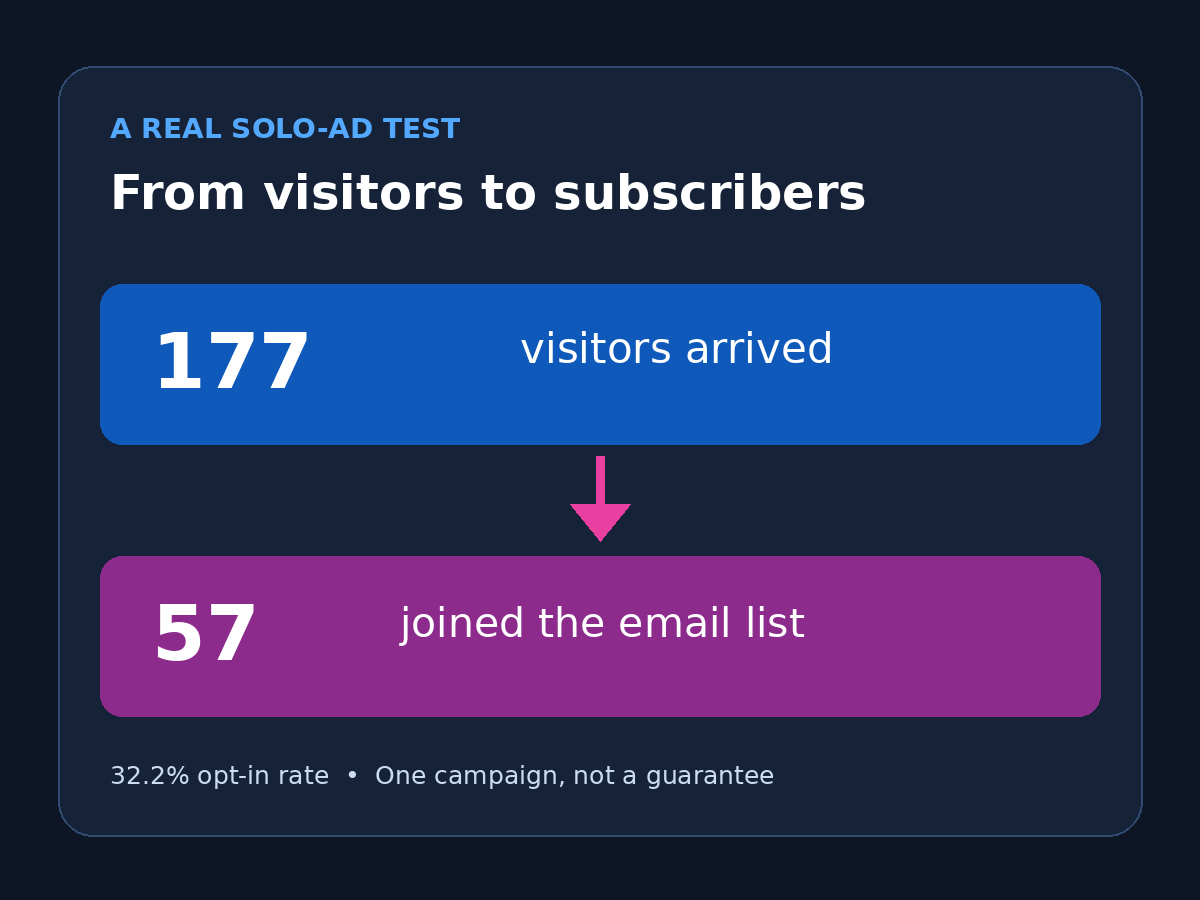
At Online Techniques, I ran a solo-ad campaign that brought in 177 visitors and produced 57 new subscribers. That's a calculated opt-in rate of approximately 32.2%.
Most of the traffic came from the United States, with additional visitors from Canada, Australia, New Zealand, and other locations. That geographic mix was relevant to the audience I wanted to reach.
Those 57 subscribers represented an encouraging result from that particular campaign. It would be misleading, however, to claim that every Udimi seller, offer, or capture page will produce the same conversion rate. The test does not establish a cost per lead or return on investment without the campaign's full cost and downstream revenue figures.
What it does demonstrate is why we measure conversions instead of celebrating clicks alone. Traffic is only the first step; the capture page and follow-up process determine whether that traffic becomes something useful to the business.
What to Have Ready Before Spending Money
A capture page that offers a clear reason to subscribe
When someone clicks through from an email, they should immediately understand what they're being offered and what to do next. Keep the headline specific, make the benefit concrete, and remove distractions that lead away from the main action.
Don't send visitors to a page that isn't working, doesn't load reliably on a phone, or asks them to make too many decisions at once. The fastest way to waste traffic is to pay for it before the destination is ready.
An email follow-up system that actually follows up
Not everyone acts on the first visit. A visitor may be curious enough to subscribe but not ready to purchase. A welcome message and a useful sequence of follow-up emails give you an opportunity to build familiarity and explain the offer at a reasonable pace.
This is why Online Techniques treats traffic generation, lead capture, and email follow-up as connected parts of a system, not isolated tools. Services such as Contact List Builder and SendShark address different aspects of audience building and follow-up; Udimi is one possible way of bringing people into that system.
How to Choose a Solo-Ad Seller Without Guessing
Look beyond the headline ratings
Udimi operates as a marketplace that also works much like a social network for solo-ad sellers and buyers. You can connect with sellers, compare options, and review feedback before deciding who to purchase from. Within the interface, you can read recent reviews, consider how frequently buyers return, look at the niche and country mix, and find a reasonable match between the seller's audience and your capture page.
A high reported sales percentage can be interesting, but remember that it describes other buyers' campaigns with different offers, follow-up sequences, and economics. It is not a promise about yours.
Set a test budget you can afford to lose
Paid traffic is an experiment with financial risk. Use money allocated for testing—not money needed for bills or essential operating expenses. Decide in advance what result would justify another test and what result would tell you to pause.
Keep your first test simple: one tracking link, one capture page, and one seller. If you change multiple things at once, it's harder to identify why results improved or declined.
One advantage of buying solo ads is that you generally won't need to write the promotional email yourself. Many sellers prefer to prepare the message because they know their own subscribers and what has worked with that audience. You supply your landing page link, and the seller develops the promotion. Confirm those arrangements with your chosen seller before ordering.
Calculate more than the click count
At minimum, track the cost per visitor, capture-page conversion rate, cost per subscriber, and the quality of engagement afterward. If you eventually know your customer value and conversion rate from subscriber to buyer, you can make better decisions about whether continued paid traffic is sustainable.
For example, an attractive opt-in rate does not automatically mean a profitable campaign. If new subscribers never engage or buy, the result needs further work. Conversely, a modest conversion rate might still be viable if those subscribers are unusually well matched to the offer.
Where Solo Ads Fit in a Smarter Online Business
Traffic is rented; your subscriber relationship can be owned
Social platforms, search engines, and purchased advertising can all introduce new visitors to your business. But you don't control those platforms, and you can't count on any single source remaining equally productive forever.
That's why the real opportunity is not merely buying clicks. It's moving interested visitors into an email list you manage, giving them a useful reason to stay, and developing an ongoing relationship through thoughtful content and follow-up.
Udimi can help start that process, but it should support an overall marketing strategy—not replace one. Combine measurable acquisition with useful information, a dependable website, a functioning email system, and regular review of results.
Should You Try Udimi Solo Ads?
A sensible next step for a prepared funnel
Udimi is worth investigating if you have a relevant offer, a working capture page, an email system, basic tracking, and a test budget. It is probably not the best starting point if your landing page is unfinished, you cannot measure signups, or you are expecting clicks alone to create sales.
My own campaign produced an encouraging number of subscribers from a relatively small visitor count, which is why I consider Udimi a tool worth explaining. But the right attitude is experimentation, not certainty: start carefully, measure the outcomes, and let the evidence—not the sales pitch—determine your next purchase.
Bottom line: Don't buy clicks just to watch a visitor counter rise. Buy a measured opportunity to introduce the right people to a system that's ready for them.